About/More Info
What's Missing?
The brightest objects in an exoplanet's sky would be:
- Other stars in multiple star systems
- Other planets in the same star system
- Moons orbiting the exoplanet itself
These aren't included - yet.
Alpha Centauri
Where is it? I'm still deciding how to make Alpha Centauri fit. Right now, you can find Rigel Kentaurus (Alpha Centauri A) and Toliman (Alpha Centauri B). It's a triple star system that you can distinguish the brightest two with low power binoculars, and so they have their own names. All other binary/triple systems are treated as one star here for now.
Notes
Know something I don't? If you're visiting from one of these systems and notice something's off, let me know. Telepathy sometimes works, or you can find me in the redwoods of Mendocino County, California.
Performance
Interactive controls:
- Zoom in and out
- Adjust star size, contrast, and magnitude cutoff
- Toggle star labels (from none to way too many)
- Show and center the Sun (Sol) in the view
- Display constellation lines and names
Constellations
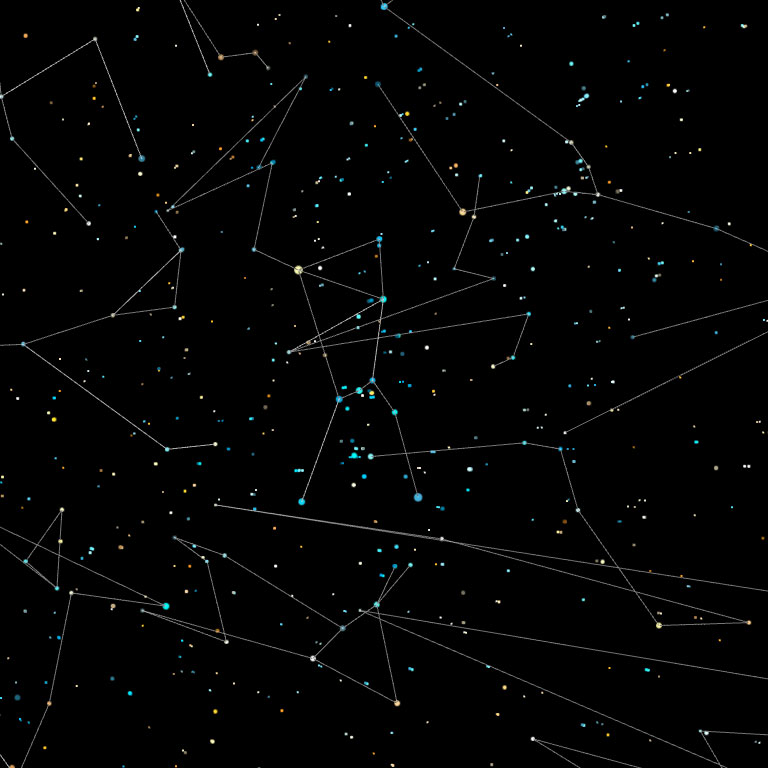
Fun fact: Constellation lines from distant vantage points look less like familiar patterns and more like jumping to lightspeed. But hey, it's fun!
However, check out what Orion looks like from here, Sirius, Procyon, and Altair:
From here:
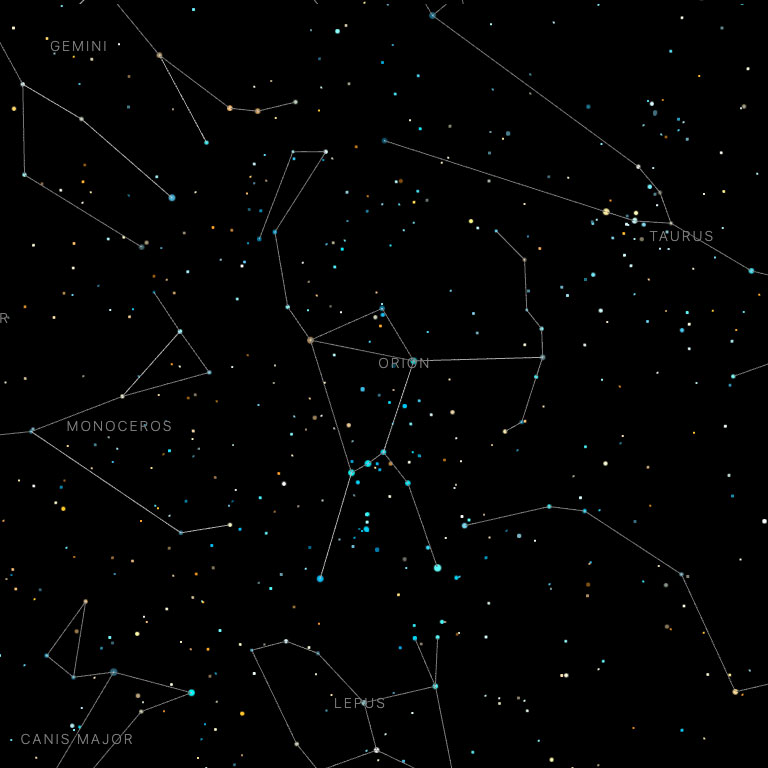
From Sirius:

From Procyon:

From Altair:
How about galaxies?
Here's a rotating visualization of 10,000 nearby galaxies.
What about our universe?
And here is one of the best sites for showing the scale of our known physical universe: Atlas of the Universe
What are your data sources?
How did you make this?
I used python, vscode, astropy, and a lot of coffee. Wrote python scripts to generate skies from different star systems, then rendered them with three.js. So, python scripts that grab raw data, generate html, css And javascript to work with three.js.
Who are you?
I'm Sid Cooperrider, a human living in Mendocino County, California. I love stargazing, coding, and making things that help people explore the universe, among other things